Bihar STET Computer Science Preparation Strategy: A 30-Day Plan
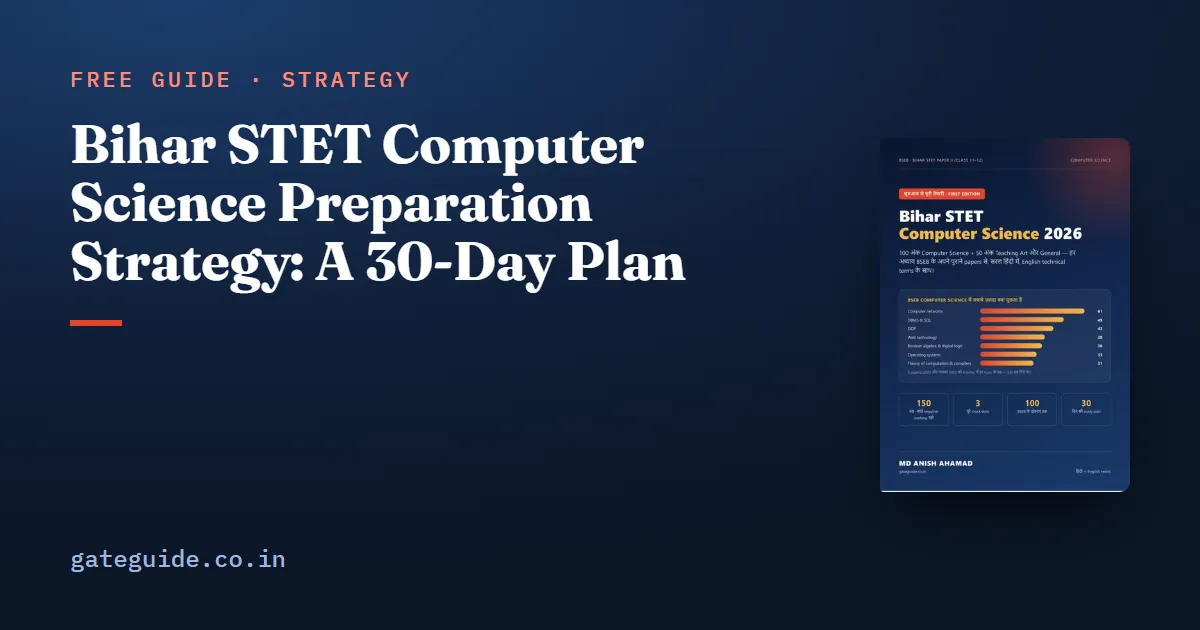
A good Bihar STET Computer Science plan is not "finish the syllabus". It is "finish the parts that carry the marks, then everything else". The past papers make this easy: five units gave almost half of the Computer Science questions, Teaching Art gave about 30 marks, and the board repeats its own questions. This 30-day plan is built on those three facts.
In this guide
Key takeaways
- Study in order of weightage: networks, DBMS, OOP, web, digital logic first.
- Give Teaching Art a fixed hour every few days — it is about 30 marks.
- Solve questions every day; recall-type questions dominate the paper.
- Keep the last week for full mock tests, repeated questions and revision.
- No negative marking: answer all 150 questions.
Before you start: three rules
1. Learn each term in English. Even if you think in Hindi, the options say "deadlock", "primary key" and "router". Write the English term next to every Hindi explanation in your notes.
2. Twenty questions after every topic. Reading feels like progress; solving shows the gaps. End each study block with a short question set.
3. One notebook for facts. Port numbers, full forms, SQL commands, theorists and their theories — one page per unit. This becomes your last-week revision.
The 30-day plan
| Days | Computer Science | General part |
|---|---|---|
| 1–3 | Computer networks: OSI and TCP/IP, devices, IP addressing, protocols and ports | — |
| 4–5 | DBMS: ER model, keys, normal forms; SQL commands and clauses | Teaching levels, phases and maxims |
| 6 | Object-oriented programming: classes, inheritance, polymorphism | — |
| 7–8 | Web technology: HTML, CSS, JavaScript, XML; Python output questions | Teaching methods |
| 9–10 | Digital logic: number systems, Boolean algebra, K-maps, gates; computer organisation | Bloom's taxonomy |
| 11–12 | Operating systems: scheduling, deadlocks, memory, files | Microteaching |
| 13–14 | Theory of computation; algorithms and complexity | Learning theories, Piaget |
| 15–16 | C and data structures; software engineering | Evaluation |
| 17–18 | IoT and cloud, machine learning basics, e-commerce, multimedia | RTE 2009, NEP 2020, inclusive education |
| 19–21 | Weak units again, with question sets | EVS and Bihar GK |
| 22–23 | Revision of the five heavy units | Maths and reasoning |
| 24 | Mock test 1 (full 150 questions, timed) | |
| 25 | Analyse mock 1; revise the weak units | |
| 26 | Mock test 2 | |
| 27 | Analyse mock 2 | |
| 28 | Mock test 3 | |
| 29 | Repeated questions list; fact notebook | |
| 30 | Light revision only; sleep early |
The weightage behind this order is in our previous year papers analysis.
How to study each unit
Networks. Make one table of the seven OSI layers with their devices and data units, and one of protocols with port numbers (HTTP 80, HTTPS 443, FTP 20/21, SMTP 25, DNS 53, SSH 22, Telnet 23). Most network questions are a line from one of these two tables.
DBMS. Learn keys and normal forms with one small example table, then SQL by command type: DDL (CREATE, ALTER, DROP, TRUNCATE), DML (INSERT, UPDATE, DELETE, SELECT), DCL (GRANT, REVOKE), TCL (COMMIT, ROLLBACK). Remember that aggregate functions go with HAVING, not WHERE.
OOP and web. These are definition-heavy. Flash cards work well: one term on the front, a one-line meaning and an example on the back.
Digital logic. Practise, do not read. Ten conversions and five K-maps a day for three days will make these questions quick.
Python. Type small programs and predict the output before running them: slicing, // and %, lists versus tuples, dictionary loops, default arguments and try–finally.
How to study Teaching Art
Teaching Art questions are facts with names attached. Study it in short sessions spread over the month rather than in one block, so the names stay with you. Our guide to Teaching Art questions lists the facts that come up most.
The last week
Take three full mock tests in exam conditions: 150 questions, 2 hours 30 minutes, no breaks. After each, spend a full day on the mistakes — reread that unit's fact page and solve twenty fresh questions on it. On day 29, read the list of repeated questions, including the ones whose official key differs from the textbook.
How to analyse a mock test
A mock test is only half done when the timer stops. Sort every wrong or skipped question into one of three groups. Did not know — the fact was never learnt, so add it to the unit's fact page. Knew but slipped — a misread word such as "not", or a calculation error, so note the trap in one line. Ran out of time — the order of attempting was wrong, so move that question type later in your next mock. After three mocks the groups show exactly where the last few marks are hiding, and the final days can go to those and nothing else.
If you are starting from zero
If you have never studied computer science, spend the first two days on fundamentals before the plan above: what hardware and software are, bits and bytes, the binary number system, input and output devices, memory types and what an operating system does. These ideas appear inside almost every unit, and once they are clear, networks and DBMS become much easier to follow. Do not worry about programming at the start; C and Python questions in this exam are short, and two focused days are enough for them later in the month.
If you have only 10 days
Cut the plan to its core. Days 1–2: networks. Day 3: DBMS and SQL. Day 4: OOP and web technology. Day 5: digital logic and number systems. Day 6: operating systems and theory of computation. Day 7: Teaching Art in one long session. Day 8: one full mock test and its analysis. Day 9: repeated questions, fact notebook and Python output practice. Day 10: light revision. You will cover less, but the units you cover gave about 70 of the 100 Computer Science questions in recent papers.
Exam-day strategy
- General part first — about 35 minutes for 50 questions.
- Then Computer Science recall questions — full forms, definitions, ports.
- Working questions last — output, conversions, K-maps, automata.
- Assertion–reason — judge the assertion alone, then the reason alone, then whether the reason explains it.
- Answer everything. With no negative marking, a blank is the only certain zero.
The complete exam pattern is in our syllabus and exam pattern guide.
Summary
- Heavy five units first, small units after day 17.
- Teaching Art in short, regular sessions.
- Questions after every topic; one fact notebook.
- Three timed mocks in the last week.
- Attempt all 150 questions.
Frequently asked questions
Can I prepare for Bihar STET Computer Science in 30 days?
Yes, if you study by weightage. Five units — networks, DBMS, OOP, web technology and digital logic — gave nearly half the Computer Science questions in recent papers, and Teaching Art gave about 30 marks. Cover those first, then the smaller units, and keep the last week for mock tests and revision.
How many hours a day should I study for Bihar STET?
Four to five focused hours a day is enough for a 30-day plan: about three hours on a Computer Science unit, one hour on Teaching Art or general topics, and thirty minutes of revision or practice questions. Consistency across thirty days matters more than a few very long days.
Which order should I attempt the paper in?
Start with the 50 general questions, which most prepared candidates finish in about 35 minutes. Then answer the Computer Science recall questions, and keep output, K-map and conversion questions for the end. Since there is no negative marking, mark an answer for every question before time runs out.
How should a beginner start Computer Science for STET?
Begin with computer fundamentals and number systems, because binary, bits and bytes appear across every unit. Then study one unit at a time with its basic terms in English, followed by twenty or thirty questions on that unit. Reading without solving questions leaves gaps that only show up in the exam.
Sources
Dates, the pattern and pass marks are set by BSEB and can change. Always confirm at biharboardonline.bihar.gov.in. GATE Guide is not affiliated with BSEB.