Bihar STET Computer Science Syllabus and Exam Pattern 2026
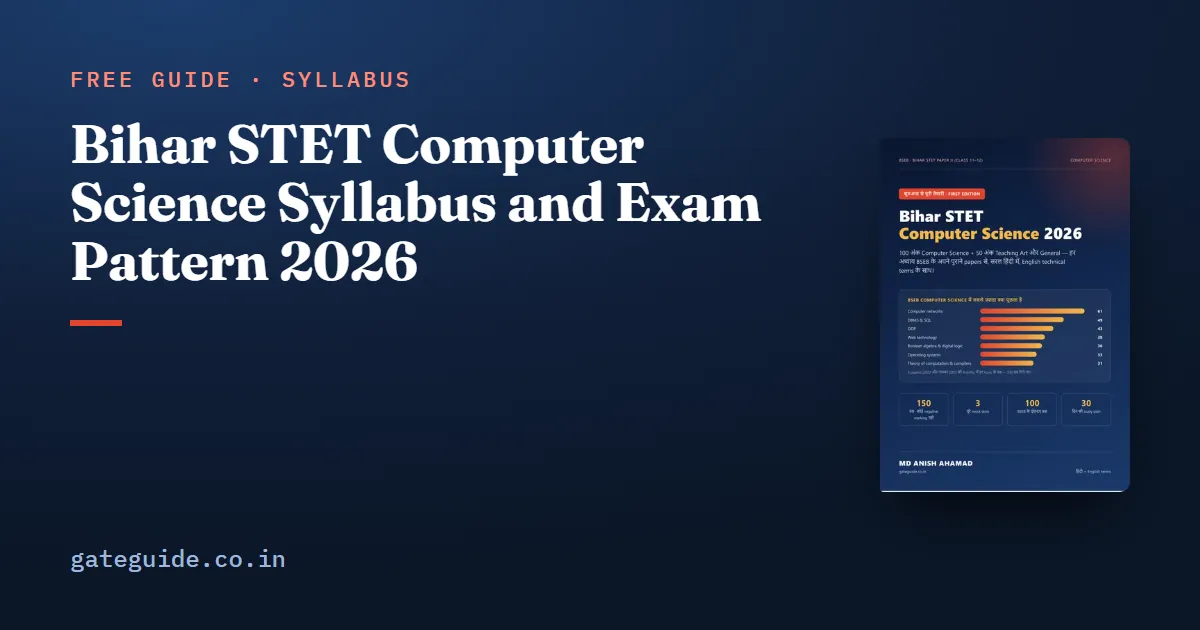
The Bihar STET Computer Science paper looks large on paper — sixteen units, from digital logic to e-commerce — but its pattern is simple and generous: 150 one-mark questions, no negative marking, and a predictable spread of topics. This guide explains the exam pattern of Paper II, walks through every unit of the Computer Science syllabus, and shows where the marks really come from.
In this guide
Key takeaways
- Paper II (Classes 11–12): 150 questions, 150 marks, 2 hours 30 minutes, computer based.
- 100 questions of Computer Science and 50 of Teaching Art and other competencies.
- No negative marking in recent papers: answer all 150.
- Networks, DBMS, OOP, web technology and digital logic give almost half of the Computer Science marks.
- Teaching Art alone gave about 30 of the 50 general marks in 2025.
The words you will meet
- STET — Special School Teacher Eligibility Test, conducted by the Bihar School Examination Board (BSEB).
- Paper I and Paper II — Paper I is for secondary teachers (Classes 9–10); Paper II is for higher-secondary teachers (Classes 11–12). Computer Science is a Paper II subject.
- Teaching Art — the pedagogy part of the paper: teaching methods, learning theories, evaluation and education policy.
- CBT — computer-based test: you read each question on screen and click an option.
Exam pattern of Paper II
| Part | Questions | Marks |
|---|---|---|
| Computer Science (subject) | 100 | 100 |
| Teaching Art and other competencies | 50 | 50 |
| Total | 150 | 150 |
The paper lasts 2 hours 30 minutes, which is one minute per question. Most general questions take less than half a minute, so a well-prepared candidate finishes them in about 35 minutes and keeps nearly two hours for Computer Science.
Inside the 50 general marks, the 2025 papers had roughly 30 questions of Teaching Art, and about five each of general knowledge, environmental studies, mathematics and reasoning. That split is not printed in a notification, so treat it as a guide to effort, not a promise.
Applications for STET 2026 closed on 22 September 2026. At the time of writing the exam date had not been announced; check the board's website and our passing marks guide for what you need to clear it.
The Computer Science syllabus, unit by unit
The syllabus is long, but each unit has a small core that the board keeps asking about.
1. Digital logic and number systems. Conversions between binary, octal, decimal and hexadecimal; complements; Boolean algebra and De Morgan's laws; K-maps; logic gates and universal gates; adders, multiplexers, decoders, flip-flops; Gray and BCD codes.
2. Computer organisation. Registers (accumulator, program counter, instruction register), the instruction cycle, addressing modes, memory hierarchy and cache, RISC and CISC, DMA and interrupts.
3. Programming in C and data structures. Data types and operators, arrays, pointers, functions, stacks, queues, linked lists, trees, graphs and hashing.
4. Algorithms. Time complexity and Big-O, searching and sorting, divide and conquer, greedy methods, dynamic programming, shortest paths and minimum spanning trees.
5. Operating systems. Processes and threads, CPU scheduling, synchronisation, deadlocks and the Banker's algorithm, paging, page replacement, file systems and I/O.
6. DBMS and SQL. ER model, keys, relational algebra, normal forms, SQL commands (DDL, DML, DCL, TCL), aggregate functions, transactions and ACID.
7. Computer networks. OSI and TCP/IP models, devices, topologies, IP addressing and subnetting, protocols and their port numbers, TCP and UDP, network security basics.
8. Software engineering. Life-cycle models (waterfall, spiral, prototype), requirements, design, DFDs, testing types, maintenance and project estimation.
9. Object-oriented programming. Classes and objects, constructors, inheritance, polymorphism, overloading and overriding, abstraction and encapsulation in C++ and Java.
10. Web technology. HTML tags and attributes, CSS, JavaScript, XML, client and server scripting, and web servers.
11. Theory of computation. Finite automata, regular expressions and languages, context-free grammars, pushdown automata, Turing machines and the phases of a compiler.
12. Internet of Things and cloud. Sensors and actuators, IoT layers, protocols such as MQTT and Zigbee, RFID, and the IaaS, PaaS and SaaS cloud models.
13. Machine learning and expert systems. Search strategies, heuristics, knowledge representation, expert systems and the types of machine learning.
14. E-commerce. B2B, B2C and C2C models, EDI, electronic payment, and security such as SSL and digital signatures.
15. Multimedia and graphics. Image, audio and video formats, compression, animation and basic graphics algorithms.
16. Python. Not listed as a separate unit, but output-based Python questions appeared in every 2025 shift.
Where the marks really come from
We counted all 500 Computer Science questions of the 2023 paper and the four November 2025 shifts. The average per paper:
| Unit | Questions per paper |
|---|---|
| Computer networks | 12.2 |
| DBMS and SQL | 9.8 |
| Object-oriented programming | 8.6 |
| Web technology | 7.6 |
| Digital logic | 7.2 |
| Operating systems | 6.6 |
| Theory of computation | 6.2 |
| Algorithms | 5.4 |
| IoT and cloud | 4.6 |
| Computer organisation | 4.2 |
The first five rows add up to about 45 questions — nearly half of the subject. The detailed counts by shift are in our previous year papers analysis.
The 50 general marks
Do not leave this part for the last week. Teaching Art questions are short and factual — who gave microteaching, what is formative evaluation, which stage of Piaget fits a Class 11 student — and the same facts return every year. Our guide to Teaching Art questions lists the ones that come up most.
The rest is light: Bihar and national general knowledge, environmental studies such as the ozone layer and Bihar's protected areas, and Class 10-level arithmetic and reasoning.
How to use the syllabus
- Start with the heavy five. Networks, DBMS, OOP, web technology and digital logic first.
- Learn terms in English. Even if you read in Hindi, the options use the English words.
- Practise output questions. Python, C and K-map questions reward practice, not reading.
- Keep 30 marks of Teaching Art safe. It is the easiest part to score in.
A day-by-day plan is in our preparation strategy.
Common mistakes with this syllabus
- Reading only theory. Questions on port numbers, SQL commands, HTML attributes and Python output need exact recall, so revise them with short question sets, not long notes.
- Ignoring the small units. IoT, multimedia and e-commerce together gave about ten questions per paper, and their questions are among the easiest in the paper.
- Skipping Python because it is not a named unit. It appeared in every 2025 shift, usually as a short program whose output you must predict.
Summary
- Paper II: 150 questions in 2 hours 30 minutes, no negative marking.
- 100 Computer Science + 50 Teaching Art and general.
- Sixteen units, but five of them give nearly half the subject marks.
- Teaching Art gave about 30 marks in 2025 — learn it early.
Frequently asked questions
How many questions are there in Bihar STET Computer Science?
Paper II has 150 multiple-choice questions of one mark each, to be answered in 2 hours 30 minutes on a computer. One hundred questions are from Computer Science and fifty are from Teaching Art and other competencies such as general knowledge, environmental studies, mathematics and reasoning.
Is there negative marking in Bihar STET?
No. In the recent STET papers a wrong answer costs nothing, so every one of the 150 questions should be answered. Leaving a question blank can only lower your score. Always confirm the rule in the instructions of your own year's notification before the exam.
Is the Bihar STET Computer Science paper in Hindi or English?
The paper is bilingual. Questions appear in Hindi and English, and technical terms such as deadlock, primary key or OSI model are used in English in both versions. Reading the subject in Hindi while learning the English terms exactly is the safest preparation.
Which units of the Computer Science syllabus carry the most questions?
Across the 2023 paper and four shifts of November 2025, computer networks gave the most questions at about 12 per paper, followed by DBMS and SQL at about 10, object-oriented programming at about 9, web technology at about 8 and digital logic at about 7.
Sources
Dates, the pattern and pass marks are set by BSEB and can change. Always confirm at biharboardonline.bihar.gov.in. GATE Guide is not affiliated with BSEB.