How to Prepare for DSSSB TGT Computer Science in 45 Days
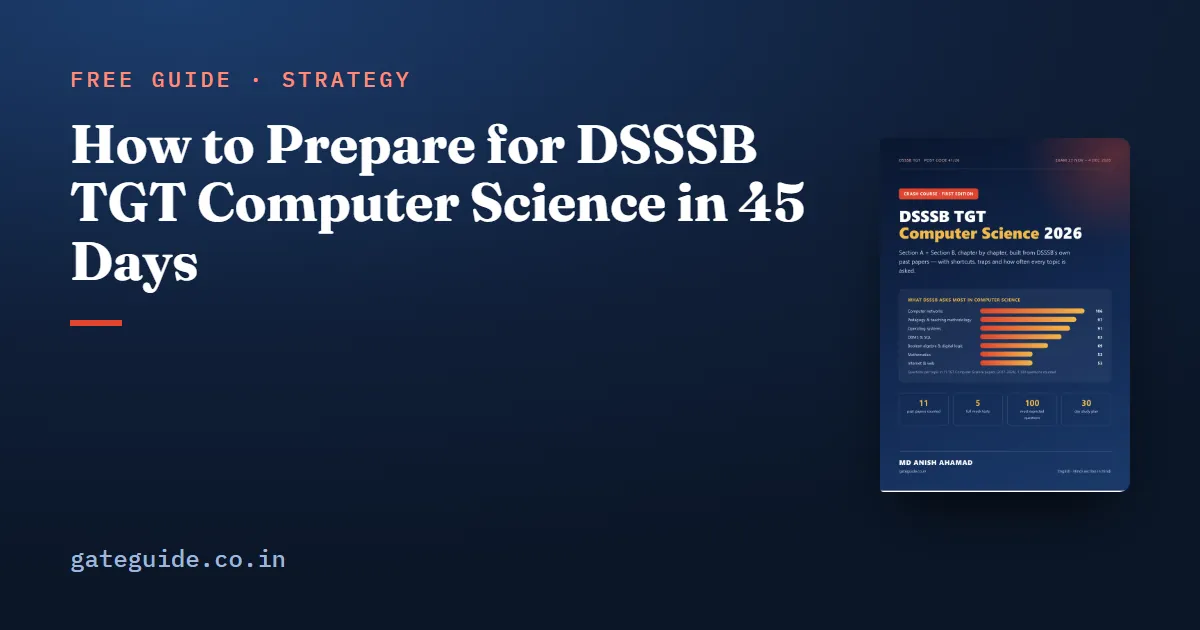
Preparing for DSSSB TGT Computer Science in 45 days is realistic if every hour goes where the marks are. This plan is built on the topic counts from 11 past TGT Computer Science papers: heavy topics first, Section A every day, and the last ten days kept for mocks. Adjust the dates to your own admit card.
In this guide
Key takeaways
- Study by weight: networks, OS, DBMS, digital logic and teaching methodology first.
- Give Section A 45–60 minutes every day from day one; it is a daily-practice subject.
- Take one diagnostic mock around day 10, then a full mock every two to three days in the last fortnight.
- Keep an error log: every wrong mock answer, the right answer, and why you missed it.
- The exam runs 27 November – 4 December 2026, so a 45-day plan starts in mid-October.
The words you will meet
- Weight — how many questions a topic gave per paper in the past. It decides how many days a topic gets.
- Error log — a notebook of your mistakes. In the last week it is your most valuable revision material.
- Full mock — 200 questions, two hours, scored with the −0.25 rule.
The plan at a glance
| Days | Section B (about 4 hours a day) | Section A (about 1 hour a day) |
|---|---|---|
| 1–6 | Computer networks; number systems | Arithmetic basics, reasoning series |
| 7–12 | Operating systems and Linux commands | English grammar, Hindi संधि-समास |
| 13–18 | DBMS and SQL; digital logic | GA static facts, reasoning coding |
| 19–24 | C, C++, Java, Python output questions | Arithmetic word problems |
| 25–29 | Web (HTML, CSS, JS, XML), data structures, algorithms | Delhi GK, English comprehension |
| 30–33 | Teaching methodology; software engineering; graphics; security | Hindi अपठित गद्यांश, reasoning puzzles |
| 34–35 | Maths, commerce and physics facts | Current affairs (last 6 months) |
| 36–45 | Full mocks every 2–3 days, error log, revision sheets | Mixed practice |
Remember: the order follows the past-paper counts in our important topics guide. If a topic is already strong for you, shorten its days and give them to a weak one.
How to study one topic in a day
- Read the concept once from your notes or book — 60–90 minutes.
- Solve the past-paper type questions for that topic — 60 minutes.
- Write a half-page sheet of the facts that keep repeating (port numbers, commands, normal forms).
- Revise yesterday's sheet for 15 minutes before starting today's topic.
Section A without stress
Section A has no separate minimum, but its marks count in the total that decides merit. Daily short practice beats a big push at the end:
| Day pattern | Section A slot |
|---|---|
| Mon / Thu | Reasoning (20 questions, 15 minutes) |
| Tue / Fri | Arithmetic (20 questions, 20 minutes) |
| Wed / Sat | English and Hindi (20 each) |
| Sun | General Awareness and Delhi GK |
Our Section A strategy lists the question types that repeat most.
The mock phase (last ten days)
From day 36, the main job is converting knowledge into marks under time pressure:
- Sit a full mock at the same clock time as your likely shift (morning if unknown).
- Attempt in this order: your strongest Section A sub-sections, then Section B, then the rest.
- Score honestly with −0.25 per wrong answer. The negative marking guide explains how many to attempt.
- Spend the next day on the error log, not on a new chapter.
Trap: taking a mock every single day in the last week leaves no time to fix mistakes. Two to three days between mocks is the right rhythm.
The last two days
Do not start anything new. Read your revision sheets and error log, check your admit card, centre route and documents, and sleep early. The exam date guide lists the shift timings.
If you are working or in college
Many candidates prepare alongside a job or final-year classes. The plan still works if you compress it:
| Time available per day | How to adapt |
|---|---|
| 5–6 hours | Follow the plan as written |
| 3–4 hours | Drop Section A to 40 minutes; keep Section B topics; merge days 34–35 into the mock phase |
| 2 hours | Study only the top five Section B topics plus teaching methodology; Section A on weekends only |
Remember: with less time, cut breadth, not the mocks. Two full mocks in the last week are worth more than one extra minor topic.
Common mistakes in the last six weeks
The first common mistake is starting with the topic you enjoy instead of the topic that carries marks. Programming is often the favourite of computer science graduates, but past papers ask more networks, operating systems and DBMS questions than programming questions. Start with the heavy topics and let the favourite be the reward later in the week.
The second mistake is collecting material instead of using it. Downloading five more books, three playlists and a dozen PDFs feels like progress but is not. One clear source per topic, plus past-paper style questions, is enough. The third mistake is taking mocks without reviewing them. A mock shows you where marks leak — a weak topic, a slow section, careless reading — and that information is only useful if you act on it the next day.
The fourth mistake is neglecting sleep and health in the last week. A two-hour paper of 200 questions needs a fresh mind more than one extra night of reading. Keep a fixed sleep time for the last ten days, and on the evening before the exam, close your books early.
Measuring progress
Every Sunday, ask three questions. Which topics did I finish this week? What was my net score in the last mock or section test? Which mistakes repeated? Write the answers in two lines. If a topic keeps slipping to the next week, shorten it to its most-asked concepts and move on; perfect coverage of one topic is worth less than solid coverage of all the heavy ones.
If you are unsure where to begin, start with the topic that gave the most questions in the past papers and work downwards. Write short notes as you go, revise them every few days, and test yourself with timed questions rather than only reading. Steady daily work over the remaining weeks is far more effective than long sessions in the final days, and it leaves you calm enough on the exam day to read every question carefully.
Quick revision
- Heavy Section B topics first; Section A every day.
- One topic a day: concept, past-paper questions, half-page sheet, revise yesterday.
- One diagnostic mock around day 10.
- Full mocks every 2–3 days in the last ten days, with an error log.
- Nothing new in the last two days.
Frequently asked questions
Is 45 days enough to prepare for DSSSB TGT Computer Science?
Yes, if you study by weight. A BCA, B.Sc Computer Science or B.Tech graduate already knows most Section B topics; the task is revision in exam form plus Section A practice. Spend the first four weeks on the heavy Section B topics, the fifth on the rest, and the last ten days on full mocks.
How many hours a day should I study for DSSSB TGT?
Five to six focused hours a day is enough for most candidates in the last six weeks - about four on Computer Science and one to two on Section A. Consistency matters more than a few very long days. Keep one hour every evening for revising what you studied that day.
When should I start mock tests for DSSSB TGT?
Take one full mock early, around day 10, only to learn your timing and weak areas. Then take a full two-hour mock every two to three days in the last two weeks. Score each with the minus 0.25 rule and keep an error log of every wrong answer.
Should I study Section A or Section B first?
Start Section B first, because the qualifying marks apply to it and its topics take longer. Do not leave Section A for the end, though - give it 45 to 60 minutes a day from the first week, rotating Reasoning, Arithmetic, English, Hindi and General Awareness.
Sources
Dates, vacancies and the syllabus are set by DSSSB and can change. Always confirm at dsssb.delhi.gov.in. GATE Guide is not affiliated with DSSSB.